

The new luxury art fair no longer begins at the booth. It begins with arrival: the hotel setting, the architecture, the social choreography, and the places to pause, listen, drink, watch, and return to.
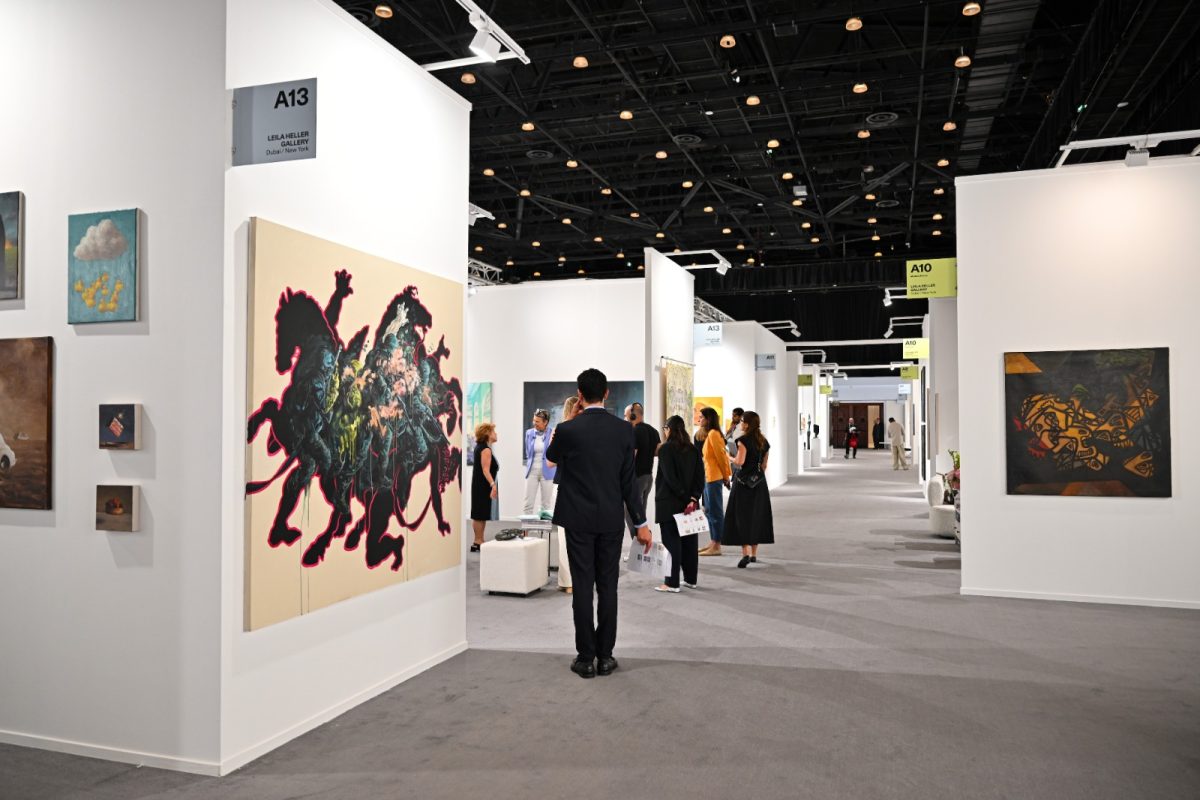
At Art Dubai’s 20th anniversary special edition, staged at Madinat Jumeirah from May 15 to 17, the fair is no longer behaving only like a commercial platform. It is behaving like a temporary cultural resort.

This shift matters because the global art market is changing. Art Basel’s 2026 market outlook points to “experience-led collecting” and notes that luxury hospitality spending is expected to exceed $390 billion by 2028, up from $239 billion in 2023. In other words, the affluent audience that once traveled to acquire objects is now traveling to inhabit worlds.
Art Dubai appears to understand this instinct well. This year’s program combines more than 75 gallery, institutional, and partner-led presentations with talks, installations, commissions, performances, poetry, film, a pop-up store, and a listening bar. The fair’s own language describes a program rooted in galleries, institutions, and communities that shaped the region’s art market and cultural scene.

For Alexie Glass-Kantor, executive director of curatorial at Art Dubai Group, the guiding idea was “things we do together.” In her interview, she described a fair built around curiosity, collaboration, and gathering, with audiences moving between galleries, performances, music, film, poetry, and installations. “It’s a fair that rewards the curious,” she said, calling this year “the most curious fair ever.”
That curiosity has become its own form of luxury. At Madinat Jumeirah, visitors are not simply being asked to look. They are being invited to linger. The Listening Bar, designed by Impaire and powered by Raw Music Store with programming by Vinyl Souk, turns part of the fair into what Art Dubai calls a “sonic sanctuary.” Elsewhere, Unwritten Poetry brings spoken word, storytelling, and open-mic sessions into the fair as spaces for reflection and shared experience.
This is where art fairs begin to resemble luxury hospitality. The best hotels today are not selling rooms alone; they sell rhythm, atmosphere, and access. Increasingly, the best art fairs are doing the same. They offer intellectual room service: a talk here, a performance there, a private encounter with an artist, a late-night program, a drink, a conversation, and a sense of having entered the right room at the right cultural moment.
Art Dubai’s Global Art Forum reinforces this direction. Its 20th edition, titled Before and After Everything and organized by Shumon Basar, reflects on rupture, continuity, media, resilience, and the forces shaping cultural thought today. It positions the fair not just as a marketplace but as a place where the region thinks in public.
The Gulf is particularly suited to this evolution. Dubai has long understood the power of hospitality as infrastructure. Its art fair now extends that logic into culture: “welcome” becomes programming, “gathering” becomes strategy, and “atmosphere” becomes value. Art Basel has already noted that all eyes are on the Gulf in 2026, with Dubai entering Art Dubai’s 20th year as an established market hub while other Gulf cities expand their own fair ambitions.
But the more interesting story is not only market growth. It is emotional design. In a fractured world, the luxury of the art fair is increasingly the ability to bring people into the same space and make them feel that culture is still alive, social, and worth travelling for.
That may be Art Dubai’s strongest statement this year. Not that art survived disruption, but that the fair has evolved into something more immersive than a sales floor. It has become a cultural stay: part salon, part stage, part listening room, part marketplace, and part city within a city.